Guidance for Agencies & Brands
A collaborative industry effort to create a shared pact, a respectful agreement between parents, agencies, and brands, to prioritise children’s rights and wellbeing in all stages of commercial content creation.
.png)
Who this is for
This guidance is for any brand, agency, or industry professional involved in the planning, commissioning, or amplification of social media content that features children.

A brand manager or marketing lead
working with creators or influencers who feature children in their content
.png)
An influencer marketing agency
creative agency, or talent manager responsible for sourcing talent or shaping campaign briefs
.png)
A media buyer or performance marketer
promoting content that includes children across paid platforms
The way we work with children in social media marketing is changing.

As social media evolves, more children are appearing in sponsored content, branded campaigns, and creator partnerships. But unlike traditional advertising, where strict rules exist to protect child actors and models, the world of online influence has grown up with few formal safeguards.
Many children are building public personas before they can understand what that means. Some are helping generate significant income, without secured access to those earnings.
Beyond compliance, this is a creative, ethical, and reputational issue. When children are involved, we must lead with care.
Our Four Pillars of Protection
This guidance is built around four essential areas of care and responsibility when featuring children in content.

Mental & Physical Wellbeing
Is the child emotionally supported, rested, and genuinely happy to be involved in the content you’re creating? Are they being treated as a child first, and not a performer?

Financial Wellbeing
If the child is contributing to commercial success, are they benefitting in a fair and future-focused way? Are there clear protections in place for their earnings?

Privacy
Does the child understand what it means to be online, and do parents have boundaries in place to limit what’s shared about their identity, routine, and environment?

Safety
Are you confident that the child is physically, emotionally, and digitally safe across every brand partnership or piece of content they’re involved in?
Mental & Physical Wellbeing
Children are not small adults, and being part of content creation can affect their mental and physical development in ways that may not be immediately visible. Even when they seem excited to be involved, it’s essential to create boundaries that protect their energy, emotions, and sense of agency.
This pillar is all about preserving their childhood first, and recognising that content creation should never feel like a job, an obligation, or a source of stress.
14%
of parent influencers consult professionals such as child psychologists to ensure content creation does not negatively impact their child’s wellbeing.
47%
of parent influencers are concerned their child may later regret being in the public eye without understanding the implications at a young age.
Source: a survey of 100 parenting influencers, Q1 2025, influencermarketingresearch.com
This shows a clear need: parents absolutely want to do the right thing, but they’re not always given the tools, space, or support to do it consistently.
Commercial partners from Brands and Agencies can help improve outcomes for children by reinforcing standards as part of collaboration requirements.
Our Guidance
Here are some things you could consider when involving your child in content creation, to ensure their emotional and physical wellbeing is protected every step of the way.

- Rigid deliverables can create pressure, especially for families with young children. Flexibility helps preserve a child-first experience.
Try This:
- Replace hard filming deadlines with suggested windows and let creators choose formats that suit their family dynamic.
- Avoid asking for content during school holidays, late evenings, or tight turnarounds.

- Scripted lines or repeat takes can push children into performative roles that feel unnatural or tiring. Children who receive praise for acting “professional,” “brilliant on camera,” or “so mature” may feel pressure to perform or behave beyond their age.
- This can impact their natural development or cause anxiety about meeting adult expectations.
Try This:
- Reinforce to creators that natural, unpolished moments are okay - and often better received.
- Avoid overly polished briefs or perfection-driven feedback when children are involved.

- Children may change their minds on the day, and that should be okay. Creators need permission to prioritise their child without risk to the partnership.
Try This:
- Add a note in the brief or contract: “If your child isn’t up for it, skip it - we’ll adapt.”
- If a child can’t express how they feel about being in content, it’s worth asking your brand or client whether they need to appear at all.
Try This:
- Offer optional child-free creative routes.

- Even if a child doesn’t see the comments immediately, the tone of public feedback can affect how they are perceived and treated by peers, and may be seen later in life.
- Harmful or inappropriate comments (including objectifying, mocking, or “overly affectionate” language) can normalise uncomfortable attention or become sources of embarrassment or distress.
Try This:
- Encourage creators to moderate comments or use filtered terms, or if the content is living on your owned channels, moderate the comments or turn them off completely. Offer to assist with hiding or disabling comments on paid content where children are present.
- Avoid amplifying posts with children via paid media if audience moderation isn’t in place.

- Content lives on beyond the campaign, especially when reposted, stitched, or used in paid media. Children may later feel uncomfortable or distressed by seeing past versions of themselves online.
- Without controls, content can be used in future campaigns without re-consent.
Try This:
- Include short-term usage windows for any content involving children. Avoid indefinite rights.
- Explicitly state that content with children will not be reused without further permission.

- When children appear regularly in content, especially branded content, it may normalise a performative relationship with their parents or audience.
- This can lead to internalising identity based on online feedback or commercial value.
Try this:
- Space out campaigns that involve a family’s child or reduce frequency where possible.

- Children may be unintentionally cast into roles - “the cheeky one,” “the smart one,” “the emotional one” - which can stick, both publicly and privately.
- This can shape how they’re treated at school, by relatives, and even by themselves.
Try this:
- Avoid scripts, captions, or hashtags that label or stereotype a child. Let creators describe moments naturally and neutrally.
Financial Wellbeing
Money can feel like a delicate subject, but when a child is involved in commercial content, it’s important to handle it with clarity, fairness, and care.
If a child is featured in branded content, or if a campaign performs well because of their presence, they deserve to benefit from that contribution in a way that’s secure and future-focused. Asking for clarity on financial arrangements for the child can increase accountability and ensure that the child’s involvement is respected and protected.
As an industry, we can lead by creating structures that respect a child’s contribution, even when the law doesn’t yet require it.
57%
of marketing professionals rely on parents to handle financial arrangements for the child, rather than offering direct compensation.
74%
of marketing professionals are unfamiliar with laws or legal protections governing child earnings in media.
52%
of parent influencers have a dedicated savings account to set aside a portion of earnings for their child.
Source: a survey of 25 brand and agency professional marketers, Q1 2025, influencermarketingresearch.com
Source: a survey of 100 parenting influencers, Q1 2025, influencermarketingresearch.com
This inconsistency means some children are building significant brand value - without guaranteed access to the income they helped create. By introducing even simple structures, families can protect that value and model financial respect.

What Are the Laws on Child Influencer Earnings?
Right now, there is no global standard protecting children’s earnings from social media content. In most countries, earnings go directly to the parent or guardian, with no legal requirement to save or protect a portion for the child.
Historically, the closest thing we can understand is the Coogan Law, which was designed to protect the earnings of child performers during the Golden Age of Hollywood - famously after child actor Jackie Coogan discovered his parents had spent nearly all of the millions he had earned.
%2Band%2BJackie%2BCoogan%2B(bottom)%2Bin%2BThe%2BKid%2B(1921)..webp)
The law, passed in California in 1939, required that 15% of a child performer’s earnings be placed into a trust, inaccessible until they turned 18. It also introduced regulations around education, work hours, and parental responsibilities. While it was groundbreaking at the time, the Coogan Law was designed for the film and television industries, and hasn’t yet been properly adapted for digital platforms or social media content, where work is often unlicensed, unpaid, or informally arranged at home.
Charlie Chaplin (centre) and Jackie Coogan (bottom) in The Kid (1921).

Current Child Influencer Laws around the World

- Only one state - Illinois - currently has a specific law protecting child influencer earnings.
- The Illinois law (2023) guarantees children under 16 receive at least 30% of earnings from monetised content that uses their likeness, name, or image.

- No specific legislation yet for children featured in social media content.
- Child performance laws require licensing for acting/modelling, but don’t clearly extend to online commercial content filmed at home.
- Guidance exists via child labour laws, but loopholes are common, especially in influencer marketing.

- Passed a law in 2020 requiring:
- 15% of income from child influencers (under 16) to be held in a protected account.
- Platforms and parents to seek permission from local authorities before monetising content featuring minors.
- Content to be removed if requested by the child later in life.



- No specific influencer legislation, though some provinces (e.g. Quebec) apply entertainment industry child labour laws.
- Legal grey area for user-generated online content involving kids.
Our Guidance
Here are some things you could consider when involving children in content creation, to ensure their financial wellbeing is protected every step of the way.
- If a child is a key focus in content, their contribution should be acknowledged with its own value.
Try this:
- Suggest a separate fee or usage clause for the child’s appearance, especially when they feature prominently or drive campaign performance.

- Contracts rarely acknowledge a child’s role - which means there’s no record of their involvement, rights, or protections.
Try this:
- Add a line item noting that a child is featured, and include a clause confirming their content will not be reused without permission.
Privacy
Children can’t truly understand what it means to have a digital presence - especially one that’s commercial, permanent, and public.
Even if the content feels light-hearted or innocent, once it’s posted, it can be copied, shared, downloaded, or archived - sometimes in ways that are completely out of your control.
57%
of marketing professionals do not have formal guidelines in place to protect a child’s privacy within content, instead placing trust in parents to manage it.
47%
of marketing professionals acknowledge potential privacy concerns for children as they grow older.
28%
of parent influencers make all decisions on behalf of their child regarding public content.
61%
of parent influencers involve their child in decisions about their online presence.
33%
of parent influencers do not discuss the benefits and drawbacks of being included in social media content with their child, believing the child is too young to understand.
Source: a survey of 25 brand and agency professional marketers, Q1 2025, influencermarketingresearch.com
Source: a survey of 100 parenting influencers, Q1 2025, influencermarketingresearch.com
Our Guidance
Here are some steps you can take to protect the child’s identity and dignity, both now and in the future.

- Avoid approving content showing school logos, uniforms, daily routines, or home locations. The same goes for content including birthdates, names, ages, or any consistent patterns that can build a full profile of a child over time.

- Not all content needs to live on the grid forever. Stories or limited-time formats can reduce long-term exposure.

- Blurred faces, over-the-shoulder shots, and nicknames help maintain a layer of protection.
- Use nicknames, emojis, or pseudonyms to add warmth while maintaining distance.
- Include privacy-friendly creative options in briefs, and avoid penalising creators who choose not to show their child’s face.

- A child cannot give informed consent to being within social media content. Whilst they may find the process fun in the moment, they aren’t truly old enough to know the long term impacts of being on social media.
- What’s fine today might not feel okay in 2 years. Respecting a family’s decision to remove or archive content is critical.
Safety
Keeping children safe isn’t just about preventing physical danger - it’s also about protecting them from emotional harm, content misuse, online risks, and inappropriate attention.
When children are involved in content, especially at scale, the potential for unintended harm increases, and brands must be prepared to act responsibly.
61%
of marketing professionals rely on parents to monitor and manage their child’s wellbeing during at-home content creation.
33%
of parent influencers do not discuss the benefits and drawbacks of being included in social media content with their child.
Source: a survey of 25 brand and agency professional marketers, Q1 2025, influencermarketingresearch.com
Our Guidance
Here are some proactive ways to protect the child’s safety before, during, and after content creation.

- Even innocent-looking content can be screenshotted, downloaded, edited, or used in harmful ways. Once something is online, it’s online for good. Even story posts can be saved and downloaded.
- Content featuring children can also attract inappropriate attention or subject them to peer ridicule or discomfort at school and in public.
What you can do:
- Avoid briefs that ask for emotionally intimate, personal, or "cute at any cost" content.
- Never request real-time posting or geotagging when children are involved.

- Families should never feel pressured to capture content that pushes past their comfort levels.
- Children should not be shown in vulnerable states, including sleepwear, bath time, punishment, or moments of distress.

- Social platforms offer tools that can reduce risk, but they’re not always used by default.
What you can do:
- Encourage creators to disable duets/stitches, downloads, and comments on posts featuring children.
- If you're amplifying content, ensure those same protections are applied on brand-owned platforms.
- Use tools like Google Reverse Image Search or social monitoring platforms to spot unauthorised reposts of the content.

- Many contracts don’t mention children at all, meaning content can be reused, repurposed, or prolonged without parental oversight.
Add specific clauses to your influencer contracts that:
- Acknowledge when a child appears in content
- Set time-bound usage rights (e.g. 3 - 6 months, not indefinite)
- Allow for content takedown at the creator’s request
- Prohibit unauthorised edits or repurposing
- Filming should never happen when a child is unwell, upset, or emotionally vulnerable.
- Reassure creators that no moment is worth capturing if it compromises their child’s emotional wellbeing.
- Be prepared to adapt campaign plans if the child isn’t in a good headspace on filming days.
Next Steps
You don’t need to change everything overnight, but small, intentional shifts in your processes can make a lasting difference in protecting children across the industry.
Here’s how to start:

Review your current practices
Revisit your influencer briefing templates, contracts, and campaign timelines. Are they flexible, child-aware, and aligned with the Responsible Kidfluence Code?

Advocate internally and externally
Share this guidance with your legal, partnerships, procurement, and creative teams. If you're an agency, talk to your brand clients about embedding these practices from pitch to post.

Use your influence
As a brand or agency partner, you set the tone. By modelling ethical, respectful practices, you encourage others to do the same, and raise the standard across the entire industry.

Build better into your workflows
Integrate the four pillars of Wellbeing, Financials, Privacy, and Safety into your standard influencer marketing processes. Add prompts, checklists, and policies where needed.

Update your contracts and briefs
Include opt-out language, privacy-conscious creative flexibility, and child-specific safeguards. Make it easy for creators to say “no” when something doesn’t feel right.
Stay part of the movement
If you’d like to stay involved with the Code as we develop industry guidance, resources, or procurement standards, we’d love to hear from you.
Join our contact list or share your experiences: we’re building this together, and your insight matters.
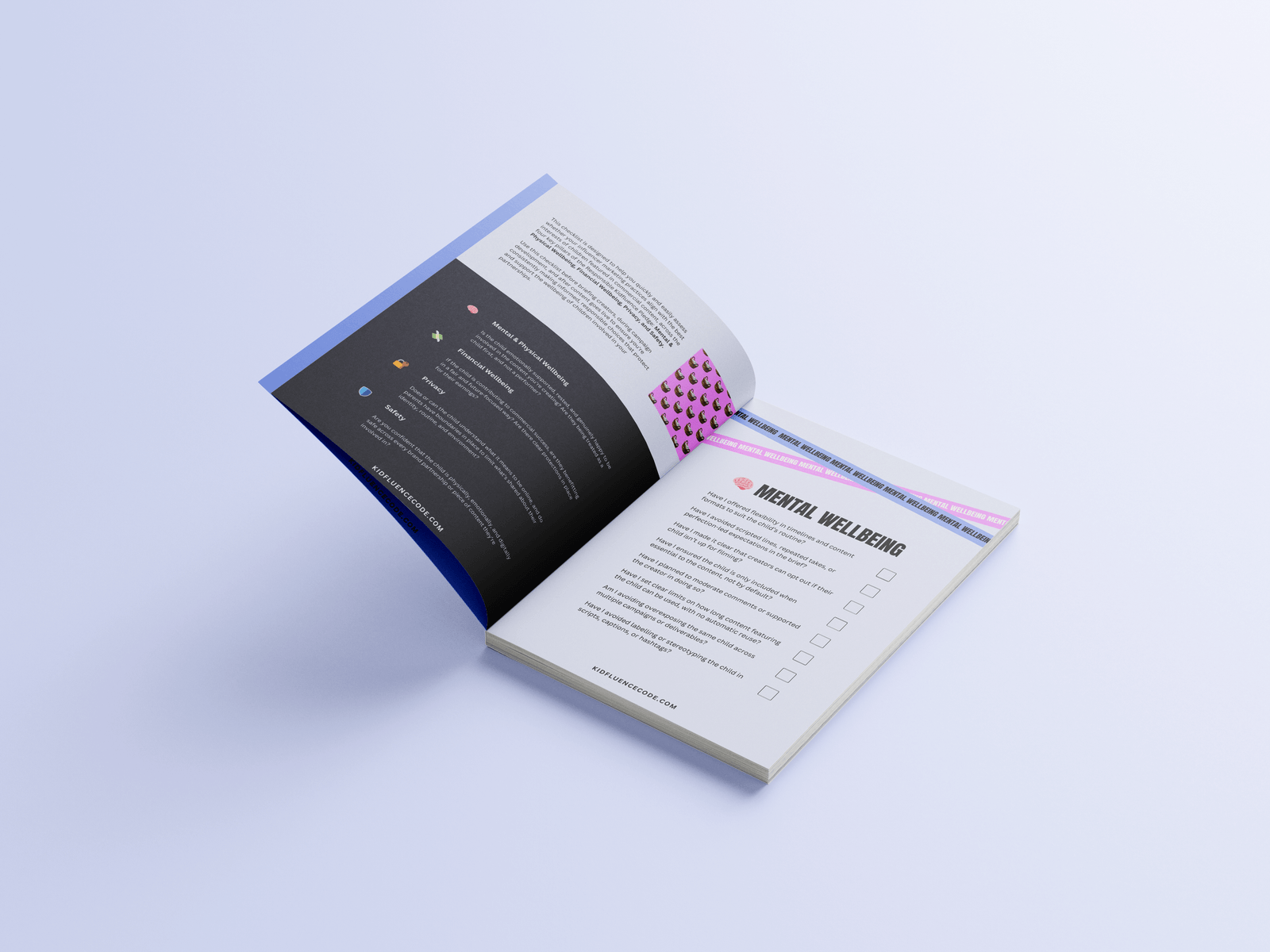
Content Care List
Download our complete booklet and reference it whenever you need practical advice. Print it, share it, use it as your handbook for keeping children safe online.
Thank you for being part of this change.
Your leadership matters.
And the next generation is worth protecting.

A final note from us...
Influencer content is powerful, but when children are involved, the stakes shift. Their presence in campaigns carries real-world consequences: financial, emotional, social, and digital. And right now, there’s no consistent safety net to protect them.
That’s why we created the Responsible Kidfluence Code, not as a rulebook, but as a support system. This guidance is an invitation for brands, agencies, and parents to come together and raise the standard for children’s wellbeing, rights, and dignity in commercial content.
As an industry, we have the influence, the tools, and the responsibility to do better.
The Responsible Kidfluence Code offers a shared framework to help you make decisions with care, design briefs with intention, and model what ethical, human-first influence really looks like.
Get in touch
Do you have anything you’d like to add?
Get in touch and let us know your thoughts!
.png)