
How to Prove the ROI of Influencer Marketing: Metrics and Methods that Convince CFOs

Influencer marketing crossed a crucial threshold in 2026. It is no longer a discretionary brand expense but a core budget line competing directly with paid media, affiliate, and CRM for quarterly investment. Yet many agencies still struggle to translate social engagement into tangible business impact. The problem is not a lack of data, it is the lack of a credible framework to interpret and present that data to boards and CFOs who see influencer spend as uncertain cash flow rather than accountable media.
Businesses now generate an average of £6.50 for every £1 spent on influencer marketing. Impressive, yes, but it hides a deeper challenge: proving which activities truly drove those returns. The reckoning has arrived, and it demands a complete shift in how agencies measure, frame, and defend influencer value.
Why Traditional ROI Reporting Fails
Most influencer reports lean on vanity metrics: reach, impressions, engagement rate, and follower growth. These figures show what happened but not why it matters. A campaign that delivers two million impressions and fifty thousand engagements can still leave a CFO asking: “Did it actually affect revenue or reduce customer acquisition cost?”
The attribution gap is the real problem. As many as 80% of influencer-driven purchases happen through untraceable journeys. A person sees influencer content, browses, leaves, returns via search or email, and converts through a retargeting ad. Traditional last-click attribution gives all the credit to the final touchpoint and none to the influencer who created the initial intent.
To make things worse, influencer results are often presented as isolated campaigns, rather than as integrated systems that feed paid media, reduce CPCs, and strengthen long-term customer value. The halo effects and cross-channel efficiencies are invisible, and therefore indefensible, in budget meetings.
Framework 1: The Executive ROI Narrative
The most persuasive ROI presentations start with business context, not just metrics. The Executive ROI Narrative (ERN) framework positions influencer marketing as an economic engine, not a creative gamble.
Step 1: Begin with the Operating System
Before sharing results, show how the campaign was designed to deliver them. CMOs and CFOs trust structure. Explain:
- Brief architecture: How creators were briefed and how performance guardrails balanced creativity.
- Rights management: What usage rights were secured and how influencer content can be reused across paid ads, CRM, or retail.
- Tracking standards: Whether UTM links, pixels, and affiliate codes were implemented consistently.
- Asset inventory: How many creative assets were generated, and what their production value would have cost via traditional means.
This reframes influencer work as a disciplined system with measurable inputs and outputs.
Step 2: Define the Value Dimensions
Influencer marketing drives value in multiple timeframes. Do not collapse it into a single percentage.
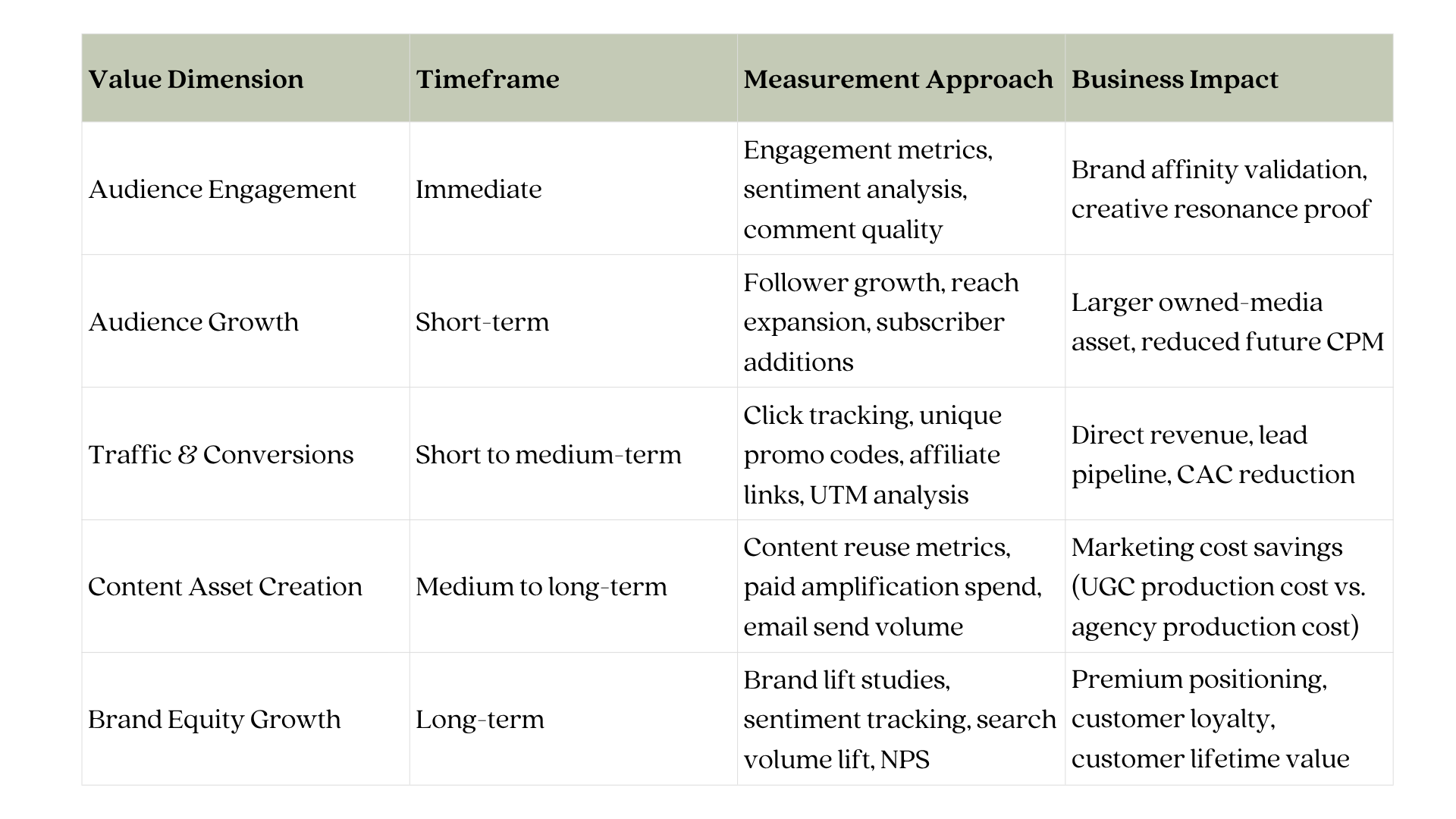
This multi-dimensional view aligns influencer work with finance logic and long-term brand value.
Step 3: Build the Influencer P&L
Frame results like a profit and loss statement.
Revenue Lines:
- Direct e-commerce sales (promo codes, affiliates): £850K
- SaaS sign-ups from influencer touch-points: £240K
- Email subscribers acquired (LTV-valued): £180K
Cost Avoidance and Asset Reuse:
- Content production savings (20 assets @ £5K each): £100K
- Paid media efficiency from influencer creative: £80K
- Organic reach lift: £45K
- Branded search volume lift: £35K
Total Value Generated: £1.53M
Programme Cost: £200K
Net Value: £1.33M
ROI: 565%
This shows influencer marketing as an investment engine with clear economic return, not an abstract creative exercise.
Framework 2: Credible Attribution Models
Why Last-Click Fails
Last-click attribution credits only the final step in a customer journey, ignoring the influencer’s early role in discovery and intent.
The Multi-Touch Solution
Multi-touch attribution assigns partial credit to every interaction.
- Linear: Equal credit across all touches.
- Time Decay: Heavier credit to recent touches, lighter to earlier ones.
- U-Shaped: 40% to first and last, 20% across the middle.
- Data-Driven: Machine learning determines influence proportionally.
To implement multi-touch attribution:
- Use standardised UTM tags and unique promo codes.
- Map the journey in analytics tools.
- Choose a model that fits your goal (awareness vs. conversion).
- Report incrementality, not correlation: for example, “Customers exposed to influencer content have 22% lower churn.”
This moves influencer data from “social proof” to “financial evidence.”
Framework 3: Brand Lift Studies
When direct attribution is limited, brand lift studies offer credible proof of upper-funnel impact.
They compare an exposed group (people who saw influencer content) with a control group (who did not). The lift in awareness, recall, or intent is then measured statistically.
If 25% of the control group plans to buy and 40% of the exposed group does, that is a 15-point lift attributable to the campaign.
Research from Swayable and Influential found influencer content nearly doubled brand favourability compared to traditional ads. This kind of rigor—95% confidence intervals, control groups, and statistical significance—earns credibility with finance teams and boards.
Framework 4: Measurement Architecture
Build a KPI Tree to connect influencer performance with business outcomes:
Awareness: CPM, engagement, saves, and shares.
Consideration: CPC, scroll depth, completion rate, sentiment.
Conversion: ROAS, CPA, AOV, and customer quality.
Long-Term Value: Branded search, email opt-ins, organic reach, and LTV.
Monthly diagnostic loops then refine strategy, refreshing underperforming content and scaling high performers. This turns influencer reporting from rear-view analysis into forward-looking optimisation.
Framework 5: The Storytelling Arc
Act 1: The Problem
Ground your story in business pain points: rising CAC, falling engagement, or lost share to competitors using influencers.
Act 2: The Solution
Position influencer marketing as peer recommendation, not advertising. Emphasise its cost efficiency, authenticity, and content reusability.
Act 3: The Proof
Present case studies with verified ROI, attribution transparency, and benchmarks below industry averages.
Act 4: The Plan
Show execution structure: creator mix, tracking, rights management, and monthly optimisation cadence.
Act 5: The Close
End with urgency, budget, and timeline. When framed this way, boards move from curiosity to conviction.
The Halo Effect: Capturing Invisible ROI
Influencer marketing’s greatest value often lives beyond immediate conversions:
- Branded search increases, reducing CPCs.
- Email lists grow with higher-quality leads.
- Organic reach improves through engagement signals.
- Customers referred by influencers show higher LTV and lower churn.
Quantify these halo effects. Compare branded search volume, CPC efficiency, and repeat purchase rates before and after campaigns. When you report £850K direct revenue plus £300K in long-term value, the total ROI becomes undeniable.
How Agencies Bring ROI to Life
For most brands, proving influencer ROI at this level of rigour requires both creative and analytical expertise. This is where agencies add real value.
An experienced influencer marketing agency builds the systems, governance, and reporting structures that make influencer programmes defensible in boardrooms.
An agency can:
- Source and manage creators with brand alignment and compliance assurance.
- Establish consistent UTM and tracking frameworks.
- Run brand lift studies and data-driven attribution modelling.
- Produce P&L-style reports for finance and C-suite audiences.
- Repurpose influencer content across paid, organic, and CRM channels for maximum ROI.
In 2026, agencies are not intermediaries but ROI translators—turning creative collaboration into financial clarity.
Practical Implementation
Infrastructure:
- Standardised UTM parameters and unique promo codes.
- Pixel tracking integrated with CRM systems.
Monthly Workflow:
Week 1: Collect data.
Week 2: Normalise for attribution.
Week 3: Analyse and diagnose.
Week 4: Report and optimise.
Measurement Integrity:
Document processes, instrument every touch-point, and benchmark results quarterly. Over time, this builds an ROI narrative that can withstand scrutiny.
The 2026 Takeaway: Turning Influence into Evidence
In 2026, influencer marketing is not judged by followers or engagement rates but by its ability to drive measurable business growth. The conversation has shifted from “Does influencer marketing work?” to “Can you prove it?”
Agencies and brands that thrive in this new landscape are those who turn influence into evidence. They use clear frameworks, consistent tracking, and credible storytelling to connect creator engagement with commercial outcomes. Every post, partnership, and piece of creator content becomes part of a measurable system - one that links awareness to acquisition, and engagement to revenue.
Influencer marketing now competes on the same level as paid media and CRM because its results can be proven, repeated, and scaled. The marketers who master this discipline will no longer need to justify influencer budgets. They will lead with numbers that tell their own story: influence translated into impact, and creativity measured in profit.
Explore Our Latest Insights
Stay updated with our latest articles and resources.









Ready to elevate your marketing strategy?
Let’s add some spice to your next campaign 🌶️